Showing posts with label tlhIngan Hol. Show all posts

2014-06-01

2014 06 01 - Star Trek III 30th Anniversary

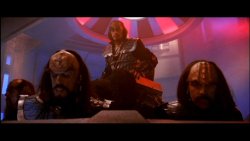
June 1, 2014 marks a very special anniversary. It's the thirtieth anniversary of these gentlemen.


"I'm with him."

Star Trek III: The Search for Spock was given its first theatrical release on June 1, 1984, thirty years ago. This means that the audience was exposed to recognisable Okrandian tlhIngan Hol for the first time.


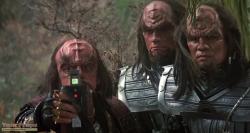
"I'm just updating my status."
"Not another food post?"
"No, they've asked me to stop posting those for some reason."


"Kids, if you two don't stop arguing, we're turning this thing around and going straight back home!"


"My translator app's frozen while it performs an automatic update."


Selfies, Klingon style


"What did I tell you about running in the corridors with sharp objects?"


"What do you think?"
"It's so you."


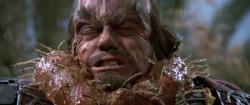
That awkward moment when you turn up at the party and Commander Kang is sporting one just like yours ...

Famous First Words


The first Okrandian Klingon words were spoken by this woman, Valkris, played by Cathie Shirriff:-


Those words were qa'vam De' vIje' rIntaH. HablI' Su' labbeH I have purchased the Genesis data. Ready to transmit.


The only English she spoke in her scene were to announce herself: "Commander Kruge, this is Valkris." The rest of her lines were Klingon.

Valkris: qa'vam De' vIje' rIntaH.
HablI' Su' labbeH.


Kruge: So'wI' yIchu'Ha'.
QaQ.
De' yIlI', DaH
.

V: jabbI'ID pItlh.
Qu'vaD lI' net tu'bej
.

K: vaj Daleghpu'.

V: HISlaH joHwI'.

K: Do'Ha'.

V: jIyaj.

K: chuyDaH.

V: Qapla', joHwI' bangwI' je.

K: batlh Daqawlu'taH.
baH
.

*Hegh valQIS*


Cathie is the first person credited with using the word Qapla' Success!.


nuq 'oH logh wejwa' pIw je'e' 'e' vISIv ...

What became of Cathie Shirriff?

Thirty years. It's been a long time.

2013-06-25

'entepray' HIvlu'! yIvem 'ej vay' yIta'!

<< First Page

A while back, I was asked to come up with a line of Klingon for this Star Trek-themed alarm clock. The line was The Enterprise is under attack! Wake up and do something!

That line translates as

'entepray' HIvlu'! yIvem 'ej vay' yIta'!

You will come across the -lu' indefinite subject verb suffix shortly.

I am bringing up this topic now, because I stumbled across that same model of alarm clock recently in a charity store. The voice and the Klingon line were exactly how I remembered them.

Since that time, tlhIngan Hol has become ubiquitous, its influence spreading far beyond the TV series and movies to infect the ordinary world. Klingon appears in interfaces of websites such as Facebook; the language has appeared on road signs, in news articles, and even in song lyrics (Marc Okrand, creator of the Klingon language, gave Kate Bush the phrase peDtaH 'ej chIS qo' as the Klingon for the sentence It is snowing and the world is white).

The language began as a jokey book launched to coincide with Star Trek III: The Search for Spock, little more than another piece of merch with as little value as that alarm clock. It has turned into something else altogether - an expression of linguistic skill, a challenge to learn and a hobby which has expanded beyond the confines of Star Trek fandom to infuse itself into common experience in a manner that neither Marc Okrand, nor Gene Roddenberry, could have ever imagined.

<< First Page

2013-06-01

Resource 1: Conversational Klingon - Now Withdrawn From YouTube

<< First Page

Until 2014 07 19, Conversational Klingon, originally released on ancient cassette tapes, was available on YouTube for your education.

Sadly, it has been withdrawn. However, your education will continue both here and on my tumblr blog, The Daily Klingon.

2013-05-25

Klingon Sentences 102 - Verb Prefixes: Spot The Pattern

<< First Page

So far, you have seen how to make simple Klingon sentences:-

jagh HoH tlhIngan The Klingon kills the enemy

Dargh maS be' The woman prefers tea

tlhIngan pup loDnal The husband kicks the Klingon

nargh tlhIngan The Klingon escapes / The Klingon is escaping

Qap HaSta The visual display is working

Now what do you make of these sentences?

Dargh vIqem I'll bring the tea / I'm bringing the tea

Dargh Daqem You are bringing the tea / You'll bring the tea

Dargh qem She is bringing the tea

What's going on here? There's only a verb and an object. The subject's missing, and what are the bits that go before the verb qem bring?

Now what about these sentences?

qara' I command you

vIra' I command him

Sara' I command you (pl.)

chora' You are commanding me / You command me

Dara' You command him

jura' You command us

Now both the subject and the object are missing, and there are other bits before the verb, which is the same in all cases: ra' command.

Is there a pattern to these? Let's see.

Try and see if you can form the following sentences, keeping the subject and object the same, and using different verbs. The verbs are HIV attack, qIp hit, Qorgh care for (look after, as in nursing) and rur resemble.

Now try out the sentences, following the above patterns - including some examples of the simple sentence types already established earlier by way of comparison.

HIvqIpQorghrur
The wife attacks the Klingon. The wife hits the Klingon. The wife cares for the Klingon. The wife resembles the Klingon.
I attack you. I hit you. I care for you. I resemble you.
I attack him. I hit him. I care for him. I resemble him.
You attack me. You hit me. You care for me. You resemble me.
You attack us. You hit us. You care for us. You resemble us.

Now did you get the following?

HIvqIpQorghrur
tlhIngan HIv be'nal. tlhIngan qIp be'nal. tlhIngan Qorgh be'nal. tlhIngan rur be'nal.
qaHIv qaqIp qaQorgh qarur
vIHIv vIqIp vIQorgh vIrur
choHIv choqIp choQorgh chorur
juHIv juqIp juQorgh jurur

What you are looking at is the most important tool in learning how to construct Klingon sentences, a construction that underpins every Klingon sentence: the Klingon subject-object verb prefix.

Every working Klingon sentence has a moHaq prefix - even the ones with a third-person subject and object such as The wife beats the Klingon; third-person subject-object sentences simply have a null prefix; just the bare verb.

The Klingon Dictionary has a table which lists all of the verb prefixes. Here it is below.

Subject (none) me you him/her/it us you (pl.) them
Object  
I jI- -- qa- vI- -- Sa- vI-
you bI- cho- -- Da- ju- -- Da-
he/she/it 0 mu- Du- 0 nu- lI- 0
we ma- -- pI- wI- -- re- DI-
you (pl.) Su- tu- -- bo- che- -- bo-
they 0 mu- nI- lu- nu- lI- 0

Notes

There is always only one subject; only one direct object.

The column headed (none) has the prefixes you would use for a verb without an object. Examples:-

I eatjISopWe eatmaSop
I sleepjIQongWe sleepmaQong
I fightjISuvWe fightmaSuv
You eatbISopYou (pl.) eatSuSop
You sleepbIQongYou (pl.) sleepSuQong
You fightbISuvYou (pl.) fightSuSuv
He/she/it eatsSopThey eatSop
He/she/it sleepsQongThey sleepQong
He/she/it fightsSuvThey fightSuv

An entry marked with -- cannot be made using verb prefixes. You need another arrangement, which will be covered in a future lesson.

An entry which is a 0 is a null prefix; there is nothing placed before the bare root verb.

Putting It Together

Let's take a look at this table again. There is something here that needs to sink in.

Every Klingon verb uses these prefixes. The root verb (qIp, Sop, HIv, rur, tIv) never changes - just the prefix changes.

tlhIngan Hol has no irregular verbs. Furthermore, it doesn't have different classes of verb (such as French, which has verbs of different classes ending in -er, -ir and -re).

Once you know the prefix table off by heart, you can conjugate every single Klingon verb the same way. Meaning that you will only ever need to learn this one table off by heart. Ever.

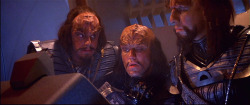
Well, when I say one table ... but that is the subject of the next lesson, Giving Commands - The Imperative Prefix.

<< First Page

2013-05-23

A Klingon Surprise

<< First Page

And now, a small surprise for you followers of Klingon Teachings.


tlhejwI', qoch - A Klingon Love Poem


Companion, Partner - translated from the original Klingon

bIHonDI' tImer.

<< First Page

Pronouncing Klingon ... That's The Easy Part! - Consonants, Part 4

<< First Page

And here, we come to the final four sounds of Klingon: the consonants v, w, y and the glottal stop '.

Where Is The Letter F?

Where is the letter F in tlhIngan Hol? The answer is: there isn't one. tlhIngan Hol was written without a letter f; in loan words with an f, use the Klingon v sound instead.

v

Klingon v is pronounced like the English vixen, venom and virulent -only with the customary extra force you must be getting used to by now. Think of the words voiced with added venom, and you get the drift.

Klingon v is also used as a substitute for the letter f in numerous loan words, such as verengan Ferengi and wo'rIv Worf.

w

Klingon w is fairly straightforward; pronounce it as in the English whisper and watch.

y

Klingon y is also fairly straightforward; pronounce it as in the English yodel and yell.

'

The ' character does not, in itself, represent a sound, but rather a cessation of sound. ' represents an interruption of sound; an sbruptness to the pattern of speech.

As with all Klingon characters, the presence of a ' is significant: paw and paw' are completely different words (they read as arrive (v) and collide (v) respectively). paw is also pronounced as in the Vulcan name T'Pau, by the way.

Let's Put It All Together

Let's try out the sounds you have learned now, beginning with Klingon Teachings, the title of this blog:-

tlhIngan paQDI'norgh

And now, try out your new-found knowledge on these challenging words:-

be'(n)woman, female
be'Hom(n)girl
be'nal(n)wife
be'nI'(n)sister
ghu'(n)situation
loDnI'(n)brother
nuv(n)person (humanoid)
roghvaH(n)population
vay'(n)somebody, someone, something, anybody, anyone, anything
voDleH(n)emperor
wIy(n)tactical display (on monitor)
wo'(n)empire
'ay'(n)section, part, component, piece
'Iw(n)blood
'u'(n)universe
ba’(v)sit
chaw’(v)allow, permit
chu’(v)engage, activate (a device)
ghov(v)recognize
HIv(v)attack
jaw(v)chat
ja'(v)tell, report
Qoy(v)hear
ra'(v)command, order
ta’(v)accomplish
tIv(v)enjoy
van(v)salute
wIv(v)choose, select
woD(v)throw away
woH(v)pick up
’ur(v)treason, commit treason

Closing Notes

These are all the sounds of Klingon you are ever going to have to learn. Once you have learned, them, you will be able to speak tlhIngan Hol with great power - which is, in the end, the most authentic Klingon accent you can have, regardless of whether your uttered words have a Welsh lilt or a Texas twang.

As for what words you would like to say, the structures of sentences and the meaning - that is the subject of the rest of this blog.

<< First Page

Pronouncing Klingon ... That's The Easy Part! - Consonants, Part 3

<< First Page

Now here come the most difficult consonants to pronounce: q, Q, r, S, t and particularly tlh.

In tlhIngan Hol, each character is distinct, and has a distinct sound. q and Q are completely different characters - ngoq and ngoQ are two completely different words with entirely unrelated meanings (code (n) and goal (n), respectively). In the Klingon vocabulary, words with an initial q are listed separately, and before, words beginning with an initial Q - thus syllables beginning with qo- come before syllables beginning with Qa-.

Likewise t and tlh are entirely separate consonants, and words beginning with t are placed ahead of words beginning with tlh in the alphabetical order listed in The Klingon Dictionary.

q

Klingon q is the tlhIngan Hol version of the c and k sounds. It is pronounced a lot more forcefully than a k, at the back of the throat. Along with H and Q, q is one of the three Klingon Hairball Consonants - in that when you are pronouncing them correctly, you sound as if you are attempting to cough up a stubborn bezoar stuck halfway down your oesophagus.

Q

Klingon Q is the loudest tlhIngan Hol consonant. You get it by rolling q and H together. As if either of them on their own was bad enough.

r

Klingon r is always rolled, with a strong burr. It is never pronounced like a French r as in rouge, and it is always pronounced - unlike the English r sound in words such as answer and dancer. Think of Klingons as all speaking with a Scottish accent. It helps.

S

Klingon S should always be pronounced like a sh as in sugar, brush and passion. However, there is more to it than that. For starters, the tip of your tongue should be placed up against the palate behind your teeth, ideally up towards the roof of your mouth where you put your tongue to pronounce D.

t

Klingon t is another forceful one - pronounced as in terror and territory, but with the same puff of air as when you are pronouncing b or p.

tlh

And now we come to Klingon tlh, arguably the most difficult consonant even to attempt to pronounce. Here goes.

First, the tip of your tongue rests in the place where you normally say D or S. Up there, against the palate.

Now, while saying t, follow it by closing off the passage of air through the tip of your tongue. The air of your breath will pass through one sidd of your tongue; not only does is ptoduce the lh sound, if you do it right you will feel the passage of your breath vibrating against the inside of your cheek. that is what tlh sounds like.

Now you can try your hand at pronouncing these words.

baS(n)metal
Dargh(n)tea
HaSta(n)visual display (on monitor)
HIq(n)wine, ale, alcoholic beverage
latlh(n)additional one, other one
parmaq(n)love, romance
parmaqqay(n)romantic companion, romantic partner
porgh(n)body
qab(n)face
Quch(n)forehead
Soj(n)food
Sub(n)hero
Sut(n)clothing
tIq(n)heart
tlhIngan(n)Klingon
buS(v)concentrate on, focus on, think only about
DuQ(v)stab
ghoS(v)go onward, approach, go away from, proceed on a course, come, follow (a course)
ghoS(v)thrust
Har(v)believe
jatlh(v)say, tell, speak
largh(v)smell (detect odour)
loS(v)wait (for)
maS(v)prefer
nargh(v)appear
nargh(v)escape
qaS(v)occur, happen
qel(v)consider, take into account
qem(v)bring
qeng(v)carry, bear, convey
qIm(v)pay attention, concentrate
qIp(v)hit (with hand, fist, weapon)
Qap(v)work, function, succeed, operate, be in operation
Qorgh(v)care for
Qum(v)communicate
reH(v)play
rur(v)resemble
SaH(v)care about
SaQ(v)cry (weep, not scream)
SIgh(v)influence
SuD(v)gamble, take a chance, take a risk
tuQ(v)wear (clothes)
tlhup(v)whisper

Now try it with the words for Klingon Language themselves:-

tlhIngan Hol

If you've got this far, and your throat hasn't been mangled by Q and tlh, majQa' Excellent! Well done!

The last few consonants, namely v, w, y and ', are covered in the next lesson.

<< First Page

Pronouncing Klingon ... That's The Easy Part! - Consonants, Part 2

<< First Page

So far, we've covered the vowels and the consonants b, ch, D, gh and H. Now, it's time to cover the consonants j, l, m, n, ng and p.

On the way, we'll ask an interesting question about tlhIngan Hol - about the absence of the letters c and k. Klingon doesn't have these letters. Why would you think that is so? I'll leave this with you to ponder.

Tongue Against Palate

The normal habit of English is to place the tongue against the tip of the incisors, the front teeth, when pronouncing most consonants. With Klingon, the trick to better pronunciation is to learn to train your tongue to curl up to touch the palate behind your teeth, closer to the roof of your mouth - particularly with the more forceful consonants such as D, S and t.

j

Klingon j is always pronounced as in the name George, and the words jerk and jail; it is never pronounced with a zh as in the French jour.

l

Klingon l is pronounced more or less the way it is in English lick and litter; but positioning the tongue against the palate adds that authentic Klingon accent to your speech.

m

Klingon m is pronounced with as much force as b, but in ta' Hol Emperor's language, the current standard dialect of Klingon, it is more or less pronounced as in minefield and mystery. In some dialects of Klingon, m sometimes comes out as b. You'll have to listen carefully, because serious misunderstandings could occur if you are unsure which dialect of Klingon is being spoken. You yourself should stick to pronouncing it in accordance with the guideline for ta' Hol.

n

Klingon n is pronounced with the tongue tip in the same place as for D, and it is pronounced in Standard Klingon, or ta' Hol, as in naughty and never. As with m above, some Klingons pronounce n as a D. It could lead to misunderstandings and some bloodshed - but you should stick to pronouncing it in accordance with the guideline for ta' Hol.

ng

Klingon ng is similar to English ng; however, unlike English where ng only occurs at the end of a syllable, Klingon ng also occurs at the beginning of some syllables and words. Pronounce ng as in the ng at the end of long, thing, sing or singer - never as in finger or danger.

p

Klingon p is pronounced with the same force as b. Always pronounce it with a little explosive sound, like English pick, peck, pickle, peppercorn only punctuated with power.

Now try pronouncing the following Klingon words from the lists of nouns and verbs presented in earlier posts:-

jagh(n)enemy
jIH(n)viewing screen
juH(n)home
jup(n)friend
loD(n)man, male
loDHom(n)boy
loDnal(n)husband
mIn(n)eye
nob(n)gift
poH(n)period of time
porgh(n)body
ghaj(v)have, possess
jach(v)scream, cry out, shout, yell
jaH(v)go, travel
jang(v)answer, reply

Next lesson covers the toughest consonants of them all: q, Q, r, S, t and especially the deal breaker, tlh.

<< First Page

Pronouncing Klingon ... That's The Easy Part! - Consonants, Part 1

<< First Page

Last time, we focused on the vowels. Now, the first batch of the consonants, and the first of your real challenges.

Here's a fun fact about tlhIngan Hol: there are no silent letters. You pronounce every letter, every vowel, every consonant and every glottal stop. In fact, you will be required to voice them with considerable force.

Never murmur or mutter in Klingon. Make your every utterance clear and strong. It is a dishonour to mutter the Warrior's Tongue. At the very least, it is disrespectful to the listener.

And now, the first five consonants.

The first five consonants of Klingon are:- b, ch, D, gh, H.

b

Klingon b is pronounced like the b in back and battle, but with more force and even a slight puff of air.

ch

Klingon ch is pronounced as in the words batch and chop; never as in Johann Sebastian Bach.

D

Klingon D is a strongly pronounced d sound, as in door and Death. Try to pronounce it with the tip of your tongue placed against the roof of your mouth, rather than the usual placement at the tip of the teeth.

gh

The closest consonant approximation to Klingon gh is the French trilled r from such French words as règle and droit.

rgh

This is a little out of order, since this should be placed after r in the appropriate section: but it is placed here since the combination rgh turns up in a lot of Klingon words such as chargh, chorgh, largh, norgh, Sargh, targh and so on. It is pronounced by rolling the r and the gh sounds together.

H

Klingon H is pronounced similar to the ch in Bach. Though again, some effort to pronounce it with force is expected.

Further Consonants

We will be looking at another batch of consonants in the next chapter. Meanwhile, practice your pronunciation of the following words from the lists listed previously.

Dargh(n)tea
Doch(n)thing
ghogh(n)voice
Hegh(n)death
Hoch(n)everyone, all, everything, each, every
HoH(n)killing
baH(v)fire (weapon)
bach(v)shoot
chagh(v)drop
choH(v)alter, change
Da(v)behave as, act in the manner of
DoH(v)back off, back away from
ghob(v)fight, battle, do battle, wage war
Hech(v)intend, mean to
Hegh(v)die
HoH(v)kill
Note that Hegh, the noun for Death and the verb for die are the same, as is HoH, the noun for killing and the verb for kill. There are a number of similar Klingon words which are both nouns and verbs - Klingon has ways of distinguishing between such words. We will explore verb prefixes and suffixes, and noun suffixes, and their meaninga and uses, in later lessons.

Next: pronunciation of the consonants j, l, m, n, ng and p.

<< First Page

2013-05-22

Pronouncing Klingon ... That's The Easy Part! - Alphabet And Vowels


bInepchu' I tell a humongous lie. Klingon is notoriously difficult to pronounce.

Difficult ... but not impossible. This article will help you to begin to learn. Mastery is up to you.


The Letters Of Klingon

tlhIngan Hol has 26 distinct letters: five vowel sounds, a whole lot of really fun consonants, and a glottal stop character ' which is a separate letter.
Klingon alphabetical order is as follows:


a, b, ch, D, e, gh, H, I, j, l, m, n, ng, o, p, q, Q, r, S, t, tlh, u, v, w, y, '

The Klingon letter names (pronouncing the ay part as in buy, chai, die, my, nigh, pie, rye etc) are:-


a'at
bbay
chchay
DDay
e'et
ghghay
HHay
I'It
jjay
llay
mmay
nnay
ngngay
o'ot
ppay
qqay
QQay
rray
SSay
ttay
tlhtlhay
u'ut
vvay
wway
yyay
'qaghwI'
Note that ch, gh, ng, and tlh are considered separate letters. The syllable no precedes the syllable nga in the dictionary. Furthermore, note that q and Q are completely separate letters: qugh cruise (v) is not the same as Qugh disaster (n).

The Vowels Of Klingon

Some of the sounds are comparatively easy to pronounce. Vowels, for example, are straightforwards.
a is always pronounced as in bath or farm. When stressed, it is pronounced as in tap or cat. Examples: vagh five (number); qatlh why? (question)

e is always pronounced as in scare or wear; stressed, it can sound like the e in set or debt. Examples: Segh type, sort, class (n); 'el enter, go in

I (which is always capitalised) is pronounced as in wizard or lizard, and as in git and fit when stressed. Examples: rIgh be lame (v); rIn be accomplished, finished (v)

o is pronounced as in door, floor or sore; as dot or shot when stressed. Examples: jor explode (v); po' be skilled (v)

u is always pronounced as in fool or stool; in a stressed syllable, like foot or soot. Examples: vuv respect (v); quS chair (n)


Vowels Followed By w or y

When a vowel is followed by w or y, the consonant changes how the vowel is pronounced.
aw - as in cow or now. Examples: paw arrive (v); chaw' permit, allow (v)
ay - as in buy or die. Examples: chay' How? (question); jay' invective (adverbial)
ey - as in say or display. Examples: jey defeat (v); Sey be excited (v)
Iy - as in key or sea. Examples: wIy tactical display (n); mIy brag (v)
oy - as in joy or toy. Examples: joy torture (v); moy'bI' slingshot (n)

Some other Klingon vowel sounds modified by w or y:-

uy - Try and say this as if you were pronouncing the word "Dewey" without the "e" sounds, kind of like the wy in "Dwy."

ew - Run the e and w sounds together; the Welsh Ewrop ("EH-OO-rop"), rather than the German Europa ("OY-ropa").

Iw - as in the sound you make when you hear something icky; "Ewww!"


Vowels Beginning Syllables

One of the more interesting things about Klingon is that, with only one exception, Klingon syllables never begin with a vowel. Klingon syllables will always begin with a consonant or '. You will not see a Klingon with like *Iw - only 'Iw, with the initial glottal stop - which is always pronounced.
The above has just been about the vowels of Klingon. The fun part, the consonants, will be the subject of the next few posts.


2013-05-20

nuqneH - Start Learning Klingon Here!


nuqneH!

nuqneH is the universal, one-size-fits-all Klingon greeting. It literally means What do you want?
This is a blog dedicated to teaching tlhIngan Hol the Klingon language as developed by Marc Okrand for Paramount for use in the Star Trek movies, from Star Trek III: The Search for Spock right through to Star Trek: Discovery.

You now know some Klingon - the title of this blog, tlhIngan Hol, tlhIngan paQDI'norgh, and now nuqneH. You will, if you stick with this blog, eventually learn many more words - nouns, verbs and other kinds of Klingon words such as adverbials, conjunctions and numbers. You will learn to speak, read and write decent working Klingon.

yIghojrup! yIqIm! yIbuS! Get ready to learn! Pay attention! Concentrate! yItIv! Enjoy!

Basic Klingon Sayings

The following are some useful Klingon sayings. You can memorise them, and for the most part when you're in company and someone is speaking Klingon these will do at a pinch, if you don't know much else about tlhIngan Hol.
Many of these come from the following sources, all of them available from Simon & Schuster and authored by Marc Okrand, creator of tlhIngan Hol for Star Trek:-

The Klingon Dictionary (essential reading)

The Klingon Way (useful sayings and proverbs)

Klingon For The Galactic Traveller (a vital adjunct to your studies)

nuqneHWhat do you want? (the standard Klingon greeting)
HIja'Yes
ghobe'No
lu'Okay (also "Sure," "Cool," "I'll do it" (response to being given an order))
toHAha!
jIyajbe'I don't understand
jISaHbe'I don't care
Do'Ha'Unfortunate
Qo'No! I won't! I refuse!
bIlughYou are right
bIlughbe'You are wrong
majGood
majQa'Excellent
tera'ngan jIHI am a Terran
tlhIngan SoH'a'Are you a Klingon?
tlhIngan Hol DajatlhlaH'a'Do you speak Klingon?
tlhIngan Hol vIjatlhlaHI speak Klingon
tlhIngan Hol vIjatlhlaHbe'I do not speak Klingon
qaSuj'a'Do I disturb you? / Am I disturbing you?
'oy''a'Will it hurt?
DujlIj yIvoqTrust your instincts
yIvoq 'ach yI'olTrust, but verify
reH bang larghlu'It is the scent that first speaks of love (literally, "A loved one is always smelled")
nuqDaq 'oH puchpa''e'Where is the bathroom?
Qapla'Success! (sometimes said on parting, though generally it's not necessary to say anything on parting company)
bortaS bIr jablu'DI' reH QaQqu' nay'Revenge is a dish that is best served cold (traditional Klingon proverb)
naDev qaS wanI' ramqu'There is nothing much happening here
HIvqa' veqlarghFeklahr (Klingon devil) strikes again! (said out loud if you make a mistake)
DopDaq qul yIchenmoH QobDI' ghu'Set fire on the side when there is danger (again, something said out loud to save your face)
not mev peghmeySecrets never cease (secrecy proverb)