Showing posts with label klingon. Show all posts

2015-02-01

Music 1: Inspirational Media

Beginning these articles on Klingon music with some inspirational media.


Below, you will see the video with subtitles.


Klingon musical forms extend back into the mists of time. As for Terrans, so too for Klingons; music inspires the Klingon spirit, stirs emotions and even brings Klingons together in common purpose, setting aside their rivalries to celebrate something greater than themselves.

Klingon musical forms are often tied up with the Klingon language form known as no' Hol, the older form of Klingon known as ancestors' language. Klingon for the Galactic Traveler has this to say about music and no' Hol.

Heard far more frequently than non-Klingon languages are various archaic forms of Klingon, dating from different time periods and originating in different regions, collectively known as no' Hol ancestors' language. The ancient forms are heard primarily, though not exclusively, in ceremonies, songs, and classical tories.

While the conventional phrases used in some rituals are uttered in modern Klingon (such as those used in the Rite of Ascension, a ceremony symbolizing a young Klingon's attainment of a certain spiritual level), those used in a great many others are in a form of
no' Hol (such as those associated with the bIreqtal [brek'tal], the ceremony in which the killer of the leader of a Klingon house marries the widow and thereby becomes the head of the house himself). In these cases, the phrases must be studied and memorized by the participants, then repeated back accurately. Improvising or paraphrasing is entirely inappropriate. Depending on when the phrases for the ritual originated, the words and grammatical constructions may be somewhat like or very different from those of modern Klingon. If the words have survived into modern Klingon but some of the grammatical features have not, it may sound as if the celebrant is speaking improper, ungrammatical Klingon. This is not the case, though the same phrase uttered away from the ritualistic context would be taken as such.

Older language forms are also often found in the lyrics of Klingon songs, particularly songs associated with rituals. Among other activities at the annual Kot'baval Festival, for example, the battle between Kahless and Molor is reenacted. While dueling with their bat'leths, the performers portraying Kahless, Molor, and other warriors sing traditional songs with words and grammatical forms that are archaic indeed, some not in everyday use for well over 1,000 years. In addition, virtually all of Klingon opera is written in
no' Hol. In order to follow an opera even superficially, one should prepare before attending a performance by studying the story. For a deeper appreciation, however, it is essential to study also the linguistic structures used in the opera's libretto. As a result, aficionados of this musical form tend to be from the upper levels of society and rather well educated, though this is not invariably the case. Finally, there are some old but still popular songs that retain old words and old grammatical forms that are not interpretable in modern Klingon. In fact, it is not uncommon for Klingon children to think some of these songs are nonsense songs, filled with silly words, and then be surprised to find out that they are ancient hunting songs or battle songs.

Finally, Klingon myths were originally told and retold, then later written down, in
no' Hol. In modern times, some are read or told in the original form, though most are familiar only in their modern translations. Even in the most up-to-date versions, however, certain lines are so famous in their original form that they are seldom altered. An example of this is found in the story of Kahless and Lukara. Following the successful defense of the Great Hall at Qam-Chee, Kahless and Lukara engage in a brief conversation that marks the start of their epic romance. Students have been memorizing these lines and repeating them for so long, they have become part of the knowledge shared by all Klingons. One need only say the first line -mova' 'aqI' ruStaq, a no' Hol way to say today was a good day to die - and everyone will know what is to follow. Interestingly, in the case of this particular conversation, the lines have been incorporated into a mating ritual that persists to this day, with the man and the woman taking the roles and repeating the no' Hol lines of Kahless and Lukara, respectively, as the prelude to a romantic encounter.

The following series of articles will look at various aspects of Klingon music, from the types of instruments played and the songs favoured by Klingons to the structure and syntax of Klingon music itself.

2014-12-07

2014 12 07: Star Trek The Motion Picture - 35 Years On

Thirty - five years ago today, December 7 1979, Star Trek The Motion Picture received its first theatrical release.

The most important aspect of this movie, as far as this blog is concerned, was this scene right at the start of the movie:-


This was the first time anybody spoke Klingon anywhere. Now here's some history for you:- the speaker, the Captain of the Imperial Klingon Cruiser Amar, was played by the late Mark Lenard - better known to Star Trek fans as Sarek, Vulcan Ambassador and father of Spock.

Furthermore, the Klingon words themselves were invented by James Doohan, most famous for playing Montgomery Scott, Chief Engineer of the USS Enterprise in Star Trek. That is, the NCC-1701. No bloody A, B, C or D.

Earlier this year, on June 1, this blog marked the thirtieth anniversary of the first time Okrandian Klingon was spoken. Today, this blog marks the thirty-fifth anniversary of the first spoken words in Klingon, anywhere.

2014-09-21

veS tIgh The Way of War

Time to start a new theme. After the delights of all that Klingon food, you'll want something to work up an appetite; and what better than to go out and fight something.

reH Suvrup tlhIngan SuvwI'A Klingon warrior is always prepared to fight
reH Heghrup tlhIngan SuvwI'A Klingon warrior is always prepared to die
bImejDI' reH betleHlIj yItlhapNever leave without your bat'telh

From today, we will be looking at Klingon weapons of all sorts - from personal melee weapons to small arms, through to the big shipboard weapons.

nuHmey Weapons


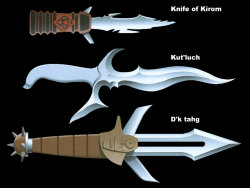
Klingons prefer fighting with bladed weapons. Some of the weapons are well-known even outside the Empire.

betleHbat'leth
DaqtaghD'k'tahg
qutluchkut'luch

betleH Bat'leth


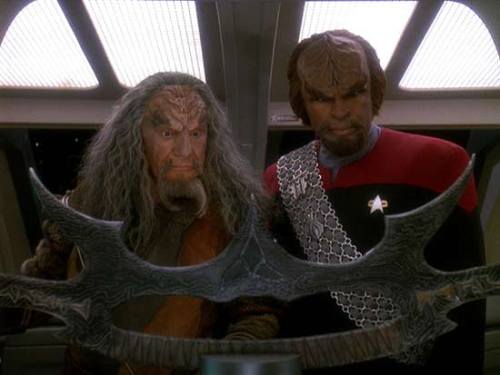
Resembling a crescent-shaped, two-ended scimitar, the bat'leth was wielded using three handholds along the outside edge of the blade. (TNG: "Reunion", et al.) A traditional bat'leth was typically approximately 116 centimeters long, with blades of composite baakonite, weighed about five-point-three kilograms, and had an exterior hand grip diameter of five centimeters.

According to Klingon mythology, the first bat'leth was forged by Kahless the Unforgettable in the 9th century. Kahless cut a lock of his hair and dropped it into the lava of the Kri'stak volcano, then plunged the burning lock into the Lake of Lusor and twisted it into a blade. After forging the weapon, he used it to fight the tyrant Molor, and then gave it its name. This story was not recorded in public texts, but was passed down verbally by the Klingon clerics as a test of Kahless' return.

meqleH Mek'leth


A mek'leth is approximately half as long as a bat'leth, typically used to slash the throat or disembowel. Good for killing Borg drones. Favoured by Worf and Jadzia Dax. First appearance: Star Trek: First Contact.

Daqtagh D'k'tahg


First seen in Star Trek III: The Search for Spock, this is a traditional warrior's blade. The Daqtagh has a single primary blade, with two secondary blades which can either be fixed or hinged. The Klingon's family crest is usually mounted on the pommel.

There will be a closer examination of Klingon weapons and combat in further posts in this series.


2013-06-25

'entepray' HIvlu'! yIvem 'ej vay' yIta'!

<< First Page

A while back, I was asked to come up with a line of Klingon for this Star Trek-themed alarm clock. The line was The Enterprise is under attack! Wake up and do something!

That line translates as

'entepray' HIvlu'! yIvem 'ej vay' yIta'!

You will come across the -lu' indefinite subject verb suffix shortly.

I am bringing up this topic now, because I stumbled across that same model of alarm clock recently in a charity store. The voice and the Klingon line were exactly how I remembered them.

Since that time, tlhIngan Hol has become ubiquitous, its influence spreading far beyond the TV series and movies to infect the ordinary world. Klingon appears in interfaces of websites such as Facebook; the language has appeared on road signs, in news articles, and even in song lyrics (Marc Okrand, creator of the Klingon language, gave Kate Bush the phrase peDtaH 'ej chIS qo' as the Klingon for the sentence It is snowing and the world is white).

The language began as a jokey book launched to coincide with Star Trek III: The Search for Spock, little more than another piece of merch with as little value as that alarm clock. It has turned into something else altogether - an expression of linguistic skill, a challenge to learn and a hobby which has expanded beyond the confines of Star Trek fandom to infuse itself into common experience in a manner that neither Marc Okrand, nor Gene Roddenberry, could have ever imagined.

<< First Page

2013-05-23

A Klingon Surprise

<< First Page

And now, a small surprise for you followers of Klingon Teachings.


tlhejwI', qoch - A Klingon Love Poem


Companion, Partner - translated from the original Klingon

bIHonDI' tImer.

<< First Page

Pronouncing Klingon ... That's The Easy Part! - Consonants, Part 4

<< First Page

And here, we come to the final four sounds of Klingon: the consonants v, w, y and the glottal stop '.

Where Is The Letter F?

Where is the letter F in tlhIngan Hol? The answer is: there isn't one. tlhIngan Hol was written without a letter f; in loan words with an f, use the Klingon v sound instead.

v

Klingon v is pronounced like the English vixen, venom and virulent -only with the customary extra force you must be getting used to by now. Think of the words voiced with added venom, and you get the drift.

Klingon v is also used as a substitute for the letter f in numerous loan words, such as verengan Ferengi and wo'rIv Worf.

w

Klingon w is fairly straightforward; pronounce it as in the English whisper and watch.

y

Klingon y is also fairly straightforward; pronounce it as in the English yodel and yell.

'

The ' character does not, in itself, represent a sound, but rather a cessation of sound. ' represents an interruption of sound; an sbruptness to the pattern of speech.

As with all Klingon characters, the presence of a ' is significant: paw and paw' are completely different words (they read as arrive (v) and collide (v) respectively). paw is also pronounced as in the Vulcan name T'Pau, by the way.

Let's Put It All Together

Let's try out the sounds you have learned now, beginning with Klingon Teachings, the title of this blog:-

tlhIngan paQDI'norgh

And now, try out your new-found knowledge on these challenging words:-

be'(n)woman, female
be'Hom(n)girl
be'nal(n)wife
be'nI'(n)sister
ghu'(n)situation
loDnI'(n)brother
nuv(n)person (humanoid)
roghvaH(n)population
vay'(n)somebody, someone, something, anybody, anyone, anything
voDleH(n)emperor
wIy(n)tactical display (on monitor)
wo'(n)empire
'ay'(n)section, part, component, piece
'Iw(n)blood
'u'(n)universe
ba’(v)sit
chaw’(v)allow, permit
chu’(v)engage, activate (a device)
ghov(v)recognize
HIv(v)attack
jaw(v)chat
ja'(v)tell, report
Qoy(v)hear
ra'(v)command, order
ta’(v)accomplish
tIv(v)enjoy
van(v)salute
wIv(v)choose, select
woD(v)throw away
woH(v)pick up
’ur(v)treason, commit treason

Closing Notes

These are all the sounds of Klingon you are ever going to have to learn. Once you have learned, them, you will be able to speak tlhIngan Hol with great power - which is, in the end, the most authentic Klingon accent you can have, regardless of whether your uttered words have a Welsh lilt or a Texas twang.

As for what words you would like to say, the structures of sentences and the meaning - that is the subject of the rest of this blog.

<< First Page

Pronouncing Klingon ... That's The Easy Part! - Consonants, Part 3

<< First Page

Now here come the most difficult consonants to pronounce: q, Q, r, S, t and particularly tlh.

In tlhIngan Hol, each character is distinct, and has a distinct sound. q and Q are completely different characters - ngoq and ngoQ are two completely different words with entirely unrelated meanings (code (n) and goal (n), respectively). In the Klingon vocabulary, words with an initial q are listed separately, and before, words beginning with an initial Q - thus syllables beginning with qo- come before syllables beginning with Qa-.

Likewise t and tlh are entirely separate consonants, and words beginning with t are placed ahead of words beginning with tlh in the alphabetical order listed in The Klingon Dictionary.

q

Klingon q is the tlhIngan Hol version of the c and k sounds. It is pronounced a lot more forcefully than a k, at the back of the throat. Along with H and Q, q is one of the three Klingon Hairball Consonants - in that when you are pronouncing them correctly, you sound as if you are attempting to cough up a stubborn bezoar stuck halfway down your oesophagus.

Q

Klingon Q is the loudest tlhIngan Hol consonant. You get it by rolling q and H together. As if either of them on their own was bad enough.

r

Klingon r is always rolled, with a strong burr. It is never pronounced like a French r as in rouge, and it is always pronounced - unlike the English r sound in words such as answer and dancer. Think of Klingons as all speaking with a Scottish accent. It helps.

S

Klingon S should always be pronounced like a sh as in sugar, brush and passion. However, there is more to it than that. For starters, the tip of your tongue should be placed up against the palate behind your teeth, ideally up towards the roof of your mouth where you put your tongue to pronounce D.

t

Klingon t is another forceful one - pronounced as in terror and territory, but with the same puff of air as when you are pronouncing b or p.

tlh

And now we come to Klingon tlh, arguably the most difficult consonant even to attempt to pronounce. Here goes.

First, the tip of your tongue rests in the place where you normally say D or S. Up there, against the palate.

Now, while saying t, follow it by closing off the passage of air through the tip of your tongue. The air of your breath will pass through one sidd of your tongue; not only does is ptoduce the lh sound, if you do it right you will feel the passage of your breath vibrating against the inside of your cheek. that is what tlh sounds like.

Now you can try your hand at pronouncing these words.

baS(n)metal
Dargh(n)tea
HaSta(n)visual display (on monitor)
HIq(n)wine, ale, alcoholic beverage
latlh(n)additional one, other one
parmaq(n)love, romance
parmaqqay(n)romantic companion, romantic partner
porgh(n)body
qab(n)face
Quch(n)forehead
Soj(n)food
Sub(n)hero
Sut(n)clothing
tIq(n)heart
tlhIngan(n)Klingon
buS(v)concentrate on, focus on, think only about
DuQ(v)stab
ghoS(v)go onward, approach, go away from, proceed on a course, come, follow (a course)
ghoS(v)thrust
Har(v)believe
jatlh(v)say, tell, speak
largh(v)smell (detect odour)
loS(v)wait (for)
maS(v)prefer
nargh(v)appear
nargh(v)escape
qaS(v)occur, happen
qel(v)consider, take into account
qem(v)bring
qeng(v)carry, bear, convey
qIm(v)pay attention, concentrate
qIp(v)hit (with hand, fist, weapon)
Qap(v)work, function, succeed, operate, be in operation
Qorgh(v)care for
Qum(v)communicate
reH(v)play
rur(v)resemble
SaH(v)care about
SaQ(v)cry (weep, not scream)
SIgh(v)influence
SuD(v)gamble, take a chance, take a risk
tuQ(v)wear (clothes)
tlhup(v)whisper

Now try it with the words for Klingon Language themselves:-

tlhIngan Hol

If you've got this far, and your throat hasn't been mangled by Q and tlh, majQa' Excellent! Well done!

The last few consonants, namely v, w, y and ', are covered in the next lesson.

<< First Page

Pronouncing Klingon ... That's The Easy Part! - Consonants, Part 2

<< First Page

So far, we've covered the vowels and the consonants b, ch, D, gh and H. Now, it's time to cover the consonants j, l, m, n, ng and p.

On the way, we'll ask an interesting question about tlhIngan Hol - about the absence of the letters c and k. Klingon doesn't have these letters. Why would you think that is so? I'll leave this with you to ponder.

Tongue Against Palate

The normal habit of English is to place the tongue against the tip of the incisors, the front teeth, when pronouncing most consonants. With Klingon, the trick to better pronunciation is to learn to train your tongue to curl up to touch the palate behind your teeth, closer to the roof of your mouth - particularly with the more forceful consonants such as D, S and t.

j

Klingon j is always pronounced as in the name George, and the words jerk and jail; it is never pronounced with a zh as in the French jour.

l

Klingon l is pronounced more or less the way it is in English lick and litter; but positioning the tongue against the palate adds that authentic Klingon accent to your speech.

m

Klingon m is pronounced with as much force as b, but in ta' Hol Emperor's language, the current standard dialect of Klingon, it is more or less pronounced as in minefield and mystery. In some dialects of Klingon, m sometimes comes out as b. You'll have to listen carefully, because serious misunderstandings could occur if you are unsure which dialect of Klingon is being spoken. You yourself should stick to pronouncing it in accordance with the guideline for ta' Hol.

n

Klingon n is pronounced with the tongue tip in the same place as for D, and it is pronounced in Standard Klingon, or ta' Hol, as in naughty and never. As with m above, some Klingons pronounce n as a D. It could lead to misunderstandings and some bloodshed - but you should stick to pronouncing it in accordance with the guideline for ta' Hol.

ng

Klingon ng is similar to English ng; however, unlike English where ng only occurs at the end of a syllable, Klingon ng also occurs at the beginning of some syllables and words. Pronounce ng as in the ng at the end of long, thing, sing or singer - never as in finger or danger.

p

Klingon p is pronounced with the same force as b. Always pronounce it with a little explosive sound, like English pick, peck, pickle, peppercorn only punctuated with power.

Now try pronouncing the following Klingon words from the lists of nouns and verbs presented in earlier posts:-

jagh(n)enemy
jIH(n)viewing screen
juH(n)home
jup(n)friend
loD(n)man, male
loDHom(n)boy
loDnal(n)husband
mIn(n)eye
nob(n)gift
poH(n)period of time
porgh(n)body
ghaj(v)have, possess
jach(v)scream, cry out, shout, yell
jaH(v)go, travel
jang(v)answer, reply

Next lesson covers the toughest consonants of them all: q, Q, r, S, t and especially the deal breaker, tlh.

<< First Page

2013-05-22

Pronouncing Klingon ... That's The Easy Part! - Alphabet And Vowels


bInepchu' I tell a humongous lie. Klingon is notoriously difficult to pronounce.

Difficult ... but not impossible. This article will help you to begin to learn. Mastery is up to you.


The Letters Of Klingon

tlhIngan Hol has 26 distinct letters: five vowel sounds, a whole lot of really fun consonants, and a glottal stop character ' which is a separate letter.
Klingon alphabetical order is as follows:


a, b, ch, D, e, gh, H, I, j, l, m, n, ng, o, p, q, Q, r, S, t, tlh, u, v, w, y, '

The Klingon letter names (pronouncing the ay part as in buy, chai, die, my, nigh, pie, rye etc) are:-


a'at
bbay
chchay
DDay
e'et
ghghay
HHay
I'It
jjay
llay
mmay
nnay
ngngay
o'ot
ppay
qqay
QQay
rray
SSay
ttay
tlhtlhay
u'ut
vvay
wway
yyay
'qaghwI'
Note that ch, gh, ng, and tlh are considered separate letters. The syllable no precedes the syllable nga in the dictionary. Furthermore, note that q and Q are completely separate letters: qugh cruise (v) is not the same as Qugh disaster (n).

The Vowels Of Klingon

Some of the sounds are comparatively easy to pronounce. Vowels, for example, are straightforwards.
a is always pronounced as in bath or farm. When stressed, it is pronounced as in tap or cat. Examples: vagh five (number); qatlh why? (question)

e is always pronounced as in scare or wear; stressed, it can sound like the e in set or debt. Examples: Segh type, sort, class (n); 'el enter, go in

I (which is always capitalised) is pronounced as in wizard or lizard, and as in git and fit when stressed. Examples: rIgh be lame (v); rIn be accomplished, finished (v)

o is pronounced as in door, floor or sore; as dot or shot when stressed. Examples: jor explode (v); po' be skilled (v)

u is always pronounced as in fool or stool; in a stressed syllable, like foot or soot. Examples: vuv respect (v); quS chair (n)


Vowels Followed By w or y

When a vowel is followed by w or y, the consonant changes how the vowel is pronounced.
aw - as in cow or now. Examples: paw arrive (v); chaw' permit, allow (v)
ay - as in buy or die. Examples: chay' How? (question); jay' invective (adverbial)
ey - as in say or display. Examples: jey defeat (v); Sey be excited (v)
Iy - as in key or sea. Examples: wIy tactical display (n); mIy brag (v)
oy - as in joy or toy. Examples: joy torture (v); moy'bI' slingshot (n)

Some other Klingon vowel sounds modified by w or y:-

uy - Try and say this as if you were pronouncing the word "Dewey" without the "e" sounds, kind of like the wy in "Dwy."

ew - Run the e and w sounds together; the Welsh Ewrop ("EH-OO-rop"), rather than the German Europa ("OY-ropa").

Iw - as in the sound you make when you hear something icky; "Ewww!"


Vowels Beginning Syllables

One of the more interesting things about Klingon is that, with only one exception, Klingon syllables never begin with a vowel. Klingon syllables will always begin with a consonant or '. You will not see a Klingon with like *Iw - only 'Iw, with the initial glottal stop - which is always pronounced.
The above has just been about the vowels of Klingon. The fun part, the consonants, will be the subject of the next few posts.