Showing posts with label klingon food. Show all posts

2014-06-15

tlhIngan Soj - Klingon Food, Part 4


Though the gastronomically uneducated might consider Klingon food to be nothing but small animals (still alive) or chunks of barely dead animals thrown together indiscriminately with odoriferous herbs, to make Klingon food properly actually involves a great deal of study, practice, and just the right touch. There are, of course, practitioners of greater and lesser skill, but one must never be careless when preparing food.
-- Klingon for the Galactic Traveler

Klingons are not carnivores. A Klingon meal can include vegetable matter of various kinds - and the jaw strength of the Klingons ensures that they can eat some pretty hard fruits and vegetables by comparison to human jaws. It's just that most Klingon food tends to be meat-based, and with some exceptions vegetables and fruits almost never form the base of a Klingon meal.

The basic term for fruit and vegetable is naH. This can cover all sorts of edible plants, from flowering tops to roots; from the whole plant to just a seed or nut. If it cannot be identified, but it is clearly of the plant kingdom, you can call it a naH.

Food can sometimes be eaten raw or unprocessed - Soj tlhol. The adjective tlhol means raw, be raw, unprocessed (v). You can cut (pe' cut (v)) part of the plant off, or break off a piece with your hands (wItlh break off with one's hands (v)) or indeed eat the food whole(naQ whole, be whole, entire (v)).


naHvam DaSopDI' naH naQ DaSopnISWhen you eat this vegetable, you must eat it whole
naHvam HochHom DaSoplaHYou can eat most of this plant
(HochHom - greater part, most of (n))
Dochvam yIlaghTake this thing apart
(lagh - take apart, disassemble (v))
'ay'vam yISopEat this piece
('ay' - part, piece, section, component, fragment (n))
naH 'ay' 'ar tu'lu'?How many pieces of fruit are there?
Soj HochHom DavutlaH 'ach tlholDI' 'ay'vam DaSopchugh qaqYou can cook most of this plant, but it is preferable to eat this piece raw

Freshness


The tlhIngan Hol term for fresh, as in freshly picked, is not ghoQ - that is the adjective that applies to freshly-killed meat, as was discussed in the previous lesson. The adjective for fresh that applies to plant matter is baQ. Another adjective applies to ripe (and overripe) fruits and vegetables - DeH ripe, be ripe, be overripe (v). Dry food is QaD dry, dried out (v).

naH baQ yIlo'Use the fresh fruit
naHvam tlhol yIpoSOpen up this raw fruit
baQbe'mo' naHvetlh naHvetlh DaSoplaHbe'You cannot eat that vegetable because it isn't fresh
baQ'a'Is it fresh?
ghobe'. DeHqu'. He'So'taHNo. It is well overripe. It is stinking.
jIQochbe'. naDev vIlarghlaHI agree. I can smell it over here

Preparation


Most vegetables and fruits are prepared in much the same way as Klingon meats - they can be marinaded in a chanDoq, stewed (Qev stew (v)), boiled (pub boil (v)), rendered like fats ('Im render (v)), mashed (tap mash (v)) or deep-fried (mIQ fry (v)).

A typical example of a vegetable which needs processing is a vegetable known as a peb'ot, a torpedo-shaped plant which is marinaded in a chanDoq; the processed vegetable is called a Hurgh pickle.

Many fruits and vegetables can also be fermented - in some cases, this is the only way to properly prepare a particular fruit or vegetable, because fermentation might be the only way to cause a particular chemical to be present in the prepared vegetable - conversely, fermentation might be the only way to cook out a disagreeable chemical present in the uncooked matter.

Verbs and Adjectivals


The following all describe the fruits and vegetables, or describe processes associated with preparing them.

Descriptions

baQfresh, be freshly picked
charslimy, be slimy
DeHripe, be ripe, overripe
gheghrough, be rough
Habsmooth, be smooth
jeDthick, be thick, dense, viscous
jejsharp, be sharp
jejHa'dull, be dull
lethard, be hard
na'salty, be salty, brackish
nonrotten, be rotten
ngalchewy
ngImputrid, be putrid
QaDdry, be dry, be dried out
rotlhtough, be tough
tunsoft, be soft
tlherlumpy, be lumpy
tlholraw, be raw, unprocessed
tlhorghpungent, be pungent
tlhorghHa'bland, be bland
vaDflexible, be flexible
wIbsour, be sour, bitter

Processes

These are processes associated with collecting and processing plant matter.

HaHsoak, drench, marinade
laghtake apart, disassemble
pe'cut
pochplant (in the ground)
QaDmoHto dry out, to desiccate
raghrot, decay
raghmoHto rot, to decay
roghferment
roghmoHto ferment
wIjto farm
wItlhbreak off
yIrgather, collect
yobharvest

Plant Matter


Satlhagriculture
Du'farm (n)
Du' naHproduce
naHfruit, vegetable
naHletnut, nuts
tIrgrain
Sortree
lavshrub
DayquSdikus plant
DIghna'type of plant
porleaf
qurghbean, beans
'oQqarroot
vIychorghsap, juice from a plant
naHnaghpip, pit, stone (hard seed at centre of fruit)
vInova' qurghFinova beans
naH chatlhvegetable soup
Hurghpickle
peb'ottorpedo-shaped vegetable
qompoghfermented, mashed mix of vegetables and optionally some animal matter
yubpeel, rind, husk, outer shell of a fruit
naHlet yubnutshell

Next, we'll be looking at Klingon beverages and that great Klingon custom of toasting.

2014-06-08

tlhIngan Soj - Klingon Food, Part 3

Klingons are, arguably unjustly, infamous throughout the galaxy for their cuisine.
-- Klingon for the Galactic Traveler


Klingons are not obligate carnivores - though, by the number of meat-based food products they consume, they might as well be.

The Klingon for meat is Ha'DIbaH. The term is also used for animal, and to insult a person. Klingon cooking uses a lot of Ha'DIbaH, whether it is fermented, coated in ngat granules or eaten straight off the bone.

Klingons exhibit ingenuity, resourcefulness, creativity and artistry in the preparation of food. This week's topic focuses on meat, and on meat cuts from the animal.

Klingon cuisine wastes no part of the animal; a Klingon would eat every part of the animal, from the skin down to the bone. What cannot be eaten on the table can easily be thrown into a 'un pot and marinaded (HaH drench, soak, steep in marinade), boiled (pub boil), stewed (Qev stew) or even fermented (rogh ferment). A good chanDoq marinade (n) uses the blood of the animal being cooked, mixed with herbs designed to enhance the flavour of the meat (tlhorghmoHwI' spice).


A good chanDoq can improve the blandest meat

Prime Cuts


Here are the typical parts consumed by Klingons. Klingons do tend to prefer their food to be fresh - the term ghoQ fresh, be freshly killed (v) here applies only to meat. Another adjective for fresh applies to fruit and vegetables - you'll have to see what that is in the next lesson.

Extremities

bemsole of foot
ghamlimb
lemhoof
movtop of foot
namwechpaw
nItlhfinger
pachclaw
qamfoot
qIvknee

There does not seem to be a term for tentacle; unless Maltz says otherwise, assume gham means tentacle as much as it means limb in an animal, whether the limb in question here functions as an arm or a leg.

Head

ghIchnose
Ho'tooth
Hughthroat
jattongue
mIneye
mongneck
nachhead
qevpobcheek
qoghear (outer)
QoghIjbrain
volchaHshoulder
woSchin
wuSlIp

The term yab means brain, but it is not used in the context of food as yab means mind. The organ called yab is used to process thought and language, and as such is not to be used as food.

Offal and Organs

The word Somraw means muscle. While muscle tissue is a major component of Klingon food, it is not the only part consumed. The versatility and artistry of Klingon cooks (and the comparative jaw strength of the Klingons) allows them to eat a delightful assortment of body parts, including various parts which other species would discard as offal:-

burghstomach
chejliver
chorbelly
DIrskin
ghabchunk of the midsection,
including any organs remaining attached
after the carving
ghab tunfilleted animal midsection, no bones
ghamlimb
ghISDenscales
HajDobanimal limb served as food
Hombone
luHintestine
pIpspine
taghlung
tIqheart
to'waQligament, tendon
tlhaghfat, tripe, dripping
tlhuQtail
veDfur
'aDvein

A mixture of different body parts is called a Daghtuj - a meat salad, as it were.

Styles of Cooking

Hunter's Meat

In the cooking style known as wamwI' Ha'DIbaH hunter's meat, a body part is coated in ngat, granulated cartilage and herbs. The specific type of part or animal replaces the word Ha'DIbaH:-

wamwI' DIrskin coated in crumbs
wamwI' mIl'oDsabre bear, hunter style
wamwI' lIngta' ghamhunter's lingta leg

wamwI' lIngta' gham vutmeH
ngat lo'bogh lIngta' gham pIDlu'
To cook hunter's lingta leg,
the lingta leg is coated in ngat granules

Emperor's Meat

Emperor's Meat (voDleH Ha'DIbaH) is a style of cooking much favoured with meat that is slightly older. As above, the specific meat replaces Ha'DIbaH in the name. This process involves marinading the organs or meat in chanDoq, the favourite condiment of every competent Klingon cook.

The aroma of a good chanDoq fills every Klingon eating establishment, sending Klingon stomachs growling in anticipation of some good, hearty eating and drinking, and having a similar effect on other diners, to go by their reflexive regurgitation of half-digested food, presumably a vestigial evolutionary instinctive drive from primitive times when they used to feed their very young offspring this way.

As for what comprises chanDoq, every Klingon chef tends to be very secretive of their individual recipes, guarding the knowledge of the components and proportions jealously. It is known that many chanDoq use animal blood ('Iw) as a main component, along with various herbs and spices to bring out the flavour of the food.

voDleH boqrat chejEmperor's Bokrat Liver
voDleH lIngta'Emperor's Lingta
voDleH bIQDepEmperor's Fish
voDleH borghel QImmeyEmperor's borgel eggs
voDleH bo'DeghEmperor's Bird
(any birdlike creature)
voDleH targhEmperor's Targ
voDleH chemvaH to'waQEmperor's chemvaH ligament

Keyvak's Meat

Keyvak (qeyvaq), a hunter of note, liked his food fermented; his style of cooking, qeyvaq Ha'DIbaH, involves fermenting meat, typically in a form of chanDoq mixed with 'atlhqam fungus to bring on the process of fermentation.

qeyvaq targh chejKeyvak's Targ Liver
qeyvaq lIngta'Keyvak's Lingta
qeyvaq Sargh QoghIjEmperor's Sark Brain

Standard Dishes

Of course, there are many standard dishes known throughout the Empire. The preparation of each kind of food is set, and does not vary. The most popular kinds of set dishes are:-


pipyus pach Pipius claw


targh tIq Heart of targ


tlhImqaH Zilm qach


tlhatlh Gladst


ro'qegh 'Iwchab Rokeg blood pie

Klingons also cherish delicacies such as Qaj tlhuQ kradge tail, tIqnagh lemDu' tiknag hooves, toqvIr lung Tokvirian skink, Duran lung DIr Durani lizard skins, bIreQtagh Bregit lung, qul DIr fire skin and tlhombus.

Fire Skin, qul DIr, is prepared by soaking bits of chopped up skin, from whatever animal is at hand, in a strong, inflammable liquor, the settig the pieces on fire. The objective is to eat the stuff quickly, while the skin is still burning.

It is considered very bad taste to try and blow out the flames.

Klombus, tlhombuS, is one of the few Klingon delicacies which requires extensive heating. In this case, the tlhombuS is a block of rendered tlhagh fat prepared hunter style, i.e. coated in ngat granules, and deep fried.

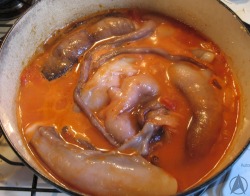
The closest Terran equivalent is this Glaswegian delicacy:-


This blog has not yet finished with the Klingon food posts. A new post will follow, this time next week.


Would you like a wafer thin mint?

2014-05-25

tlhIngan Soj - Klingon Food, Part 2

A well-fed warrior is prepared to battle any enemy and claim glory for the Empire; a warrior displeased with his meal looks to the cook for retribution.
-- Klingon for the Galactic Traveler

And so we come to the next stage in our examination of the eating habits of Klingons. Today, we will be taking a close look at the most famous item in the Klingon culinary repertoire.


qagh gagh, aka serpent worms.

Gagh is a delicacy whose fame extends beyond the boundaries of the Klingon Empire. What is generally not known is that gagh comes in at least 51 varieties, each with its own quirks and textures. Some of the named varieties of gagh are:-

Wistan gagh: this comes packed in targ blood.

Filden gagh: this variety squirms.

Meshta gagh: this variety jumps

Torgud gagh: this is the variety which wiggles

Bithool gagh has feet.

Gagh preparation


Klingon for the Galactic Traveler has this to say about gagh.

Perhaps the most representative Klingon food, certainly the one best known outside of the Empire, is gagh (or, in Klingon, qagh): serpent worms in a thick sauce (called ghevI'). Prior to the preparation of this dish, the worms are fed only 'Iw puj ("diluted blood"; literally, "weak blood"), which the worms find unappetizing and therefore consume only when they are nearly starving.


The type of animal from which the blood has been taken has a great deal of influence on the eventual flavor of the qagh, and individual cooks, as well as individual eaters, have their own preferences. As the final step in preparing the dish, the worms are poured into a bowl filled with the ghevI' (sauce), which contains, among other ingredients, pellets of an extremely flavorful herb that the hungry worms quickly ingest, even though it is toxic to them and kills them within minutes. Since qagh is considered best if consumed while the worms are still alive, it is important to keep the worms out of the sauce until just before the dish is served. For the same reason, it is customary to eat qagh as quickly as possible. If, for some reason, the qagh cannot be consumed before they all die, the entire mixture of qagh and ghevI' is saved and later heated up as a sort of stew (the general term for which is tlhIq; thus, qagh tlhIq may be translated as "qagh stew"). Although not as desirable as live qagh, this is a common way to serve leftovers.


The key terms are:-

qaghgagh
'Iw pujweak blood
targh 'Iwtarg blood
ghevI'sauce in which gagh is served
qagh tlhIqgagh stew

Klingon Sayings Connected To Gagh


The following popular sayings appear in The Klingon Way: A Warrior's Guide:-

qagh Sopbe'!He doesn't eat gagh!

Everyone loves gagh, so if one is not eating it, something must be wrong. This expression is used to mean that there is something wrong with someone or that someone is acting suspiciously. It is also a way to refer to somebody as a coward.

For Klingons, among whom cursing is a highly developed art form, this is a rather mild dismissive remark, not a strong insult. As this expression demonstrates, even though Klingon culture in known for its directness, it is also capable of expressing ideas subtly.

qagh HoHkill gagh

Gagh, the Klingon delicacy consisting of serpent worms in a sauce, is ideally eaten while the worms are still alive. To kill gagh (qagh HoH), therefore, is counterproductive, to say the least, and that is the notion this idiom conveys. The phrase is applied to a person and means that he or she is doing something counterproductive:

SuyDuj DaQaw'chugh qagh DaHoHIf you destroy the merchant ship, you kill gagh
SuyDujmerchant ship
DaQaw'chughIf you destroy it

-- that is, destroying the merchant ship is contrary to the best interests of the current mission.

yIntaHbogh qagh jablu'DI' reH nIvqu' qaghGagh is always best when served live

When Klag said this to William Riker, he was speaking literally, actually talking about the Klingon delicacy gagh, or serpent worms. The same expression, however, is often used figuratively to mean that a fight is always better when there is a worthy adversary, or that one should always want to face real challenges.

Next week: An interruption for a very special post. The food posts resume 2014-01-08.

2014-05-18

tlhIngan Soj - Klingon Food, Part 1

And so we come to the big post. Klingon food. What do Klingons consider to be good eating?

Due to the high Klingon metabolism, eating and drinking are an important part of Klingon life next to fighting. A full Klingon meal may consist of between four and five dishes.

Klingons enjoy a variety of good food. Not all of it looks like piles of cold offal unceremonoously slapped onto the plate or eaten live and still squirming. Klingon food can be prepared a number of different ways, including coating in crumbs, soaking in a marinade, stewing or even partial fermentation. Some food is boiled or rendered, some frozen, and some recipes do actually call for the food to be deep-fried.


Typical Klingon meals include breakfast, lunch, dinner and the midnight snack - actually often a full meal unto itself.

nIQbreakfast
meghlunch
'uQdinner
'uQ'a'banquet, feast
ghemmidnight snack
nay'dish, course

The people who prepare food and drinks have a variety of different titles. The basic preparer of food, whether solid or liquid, is known as a vutwI'. Sometimes, a separate jabwI' server serves the food - the verb jab means to serve food (or drinks). A bartender who serves drinks in a bar is known as a chom. The place where each serves is called Qe' restaurant and tach bar, respectively.


Fast food exists in the Klingon Empire, known as moD Soj - literally the food hurries. Such a place, known as a Do Qe' velocity restaurant, does not have a vutwI' - instead, they have a tebwI', a (plate) filler.

vutwI'cook
jabwI'server
chombartender
tebwI'fast food worker
Qe'restaurant
Do Qe'fast food place
moD Sojfast food

Hapmey lI' Useful Substances


There are a number of useful substances which are used by Klingons in food preparation, but which themselves are not considered food. They are used as part of food preparation.

An example is 'atlhqam, a kind of fungus which is used to ferment various kinds of meat or vegetables. 'atlhqam is scraped (tey scrape) from trees, but it is also found between the toes of certain animals.

'atlhqam vIlo'bogh Ha'DIbaH vIrogh, 'ej vIwechI ferment the meat with the fungus and serve it at its peak

'atlhqamtype of fungus used to ferment food
roghferment
wechserve food at its peak

Sometimes, living animals are used to process the food. A sauce called quD is produced by digesting a substance called Su'lop in the stomach of an animal; at its peak, the quD is cut out of the animal's belly and served with a flourish. The process is called Suqqa':-

quD vISuqqa'I obtain the quD

In the absence of a suitable animal, the chef uses a vat and a mix of enzymes which digests the quD artificially - the result is called 'un quD pot quD, and while it is chemically identical to the naturally-produced burgh quD stomach quD Klingons would prefer the natural burgh quD when it is available.


Another common substance is ngat. This is a granulated cartilage mixed with a grain (tIr grain) and is typically coated over the food being prepared. The verb for this is pID. The closest translation for ngat is breadcrumbs, even though no actual breadcrumbs are used to make the ngat.

ngat vIlo'bogh lIngta' gham vIpIDI I coat the lingta limb with breadcrumbs

chanDoq is a very common Klingon food substance. chanDoq is a marinade. Every chef worth his salt has a stock of chanDoq. It could be said that each Klingon chef's chanDoq is different. Every Klingon chef guards the recipe for his chanDoq with ferocity. The process of soaking or drenching the food in the chanDoq is called HaH.

chanDoq vIlo'bogh lIngta' gham vIHaHI I steep the lingta limb in the marinade

Sometimes, the chanDoq is thickened to form a chanDoq jeD thick chanDoq - this is served as a sauce. Other kinds of sauces include 'uSu', which is usually served in a jug as an accompaniment to gladst (tlhatlh 'uSu' bal means gladst with jug of 'uSu'), ghevI' which is the sauce in which qagh is usually served, and the concoction of animal blood, herbs and condiments in which some food is stewed - the verb to stew is Qev.


Next: More Klingon food.